SOME LINKS FOR SESSION 3, APRIL 13
- World Bank Governance Indicators. The WB's Worldwide Governace Indicators (WGI). Click on Access Governance Indicators, and pick a country.
- Fraser Institute's Economic Freedom of the World report. See the Country Data Tables.
- World Economic Forum's chart on judicial independence.
- Freedom House's Freedom of the Press Survey.
- Ai Weiwei. David Piling: “Lunch with the FT: Ai Weiwei”, Financial Times, April 23, 2010. From one of his tweets: "No outdoor sports can be more elegant than throwing stones at autocracy; no melees can be more exciting than those in cyberspace". See his work at Haus der Kunst in Munich [see]; he also consulted with Swiss architects Herzog & de Meuron for the design of the Olympic Stadion in Beijing (The Nest). Says Ai Weiwei:
CHINA IS A COLOURFUL COUNTRY AND THERE IS A LOT OF FREEDOM. YET THE LACK OF AN INDEPENDENT JUDICIARY AND STATE LIMITS ON FREE SPEECH ARE FATAL FLAWS. CHINA IS LIKE A RUNNER SPRINTING VERY FAST BUT WITH A HEART CONDITION.
[DOCUMENT: “Who is afraid of Ai Weiwei?”]
See also Edward MacMillan-Scott: “Ai Weiwei's arrest is part of China's new crackdown”, The Guardian.
- Ambrogio Lorenzetti. Video; Justice; Good government in the countryside; Tyranny.
- Francis Fukuyama. The Origins of Political Order, Vol. 1 (New York: Farrar, Strauss & Giroux, 2011) [web] [Nicholas Wade: "From ‘End of History’ Author, a Look at the Beginning and Middle", The New York Times] [video].
Showing posts with label Session 3. Show all posts
Showing posts with label Session 3. Show all posts


Tuesday, April 5, 2011
 The Political Economy of Credit Markets – Putting politics back into the credit market!
* * *
International Political Economy - Agustin Mackinlay
_________________
The Problem…
We now reach a key point in our IPE program! Normally at this stage, instructors would introduce central banks, short-term interest rates, monetary policy. Equipped with these tools, they would perhaps tackle the 2008 financial crisis. But I refuse to take that road. It deviates from one of the key points in today’s IPE scenario: the rise of new Great Powers (BRICs and others). What I have in mind is an altogether more ambitious project: LET US REINTRODUCE POLITICS INTO THE CREDIT MARKET!
What I call the Political Economy of the Credit Market is part of a research project of mine; it is the result of many years of reading and … traveling! South America, Mexico, Central America, Vietnam, The Philippines, Russia, Continental Europe, London, New York, San Francisco, New Zealand and —crucially— The Netherlands. The Political Economy of the Credit Market will help us better understand what David Landes called The Wealth and Poverty of Nations. Why Some are so Rich and Some so Poor (New York: 1998, W.W. Norton).
Consider column [6] in the table. The Netherlands have the largest bond market in terms of GDP (229%), while Peru ranks the lowest (12%). What is a bond? It is a CONTRACTUAL OBLIGATION that specifies the name of the issuer, the size of the issue, the way (and the dates) interest rate and principal payments are to be paid. Companies and governments issue bonds to finance innovation and public spending. What is GDP? The value of all goods and services produced in a given year.
If the Netherlands’ GDP amounts to $650 billion, then the size of its bond market is about … $1488.5 billion. (Peru numbers: $250 bn GDP; $30 bn size of bond market). No wonder the Netherlands are considered one of the wealthiest countries on the planet!
[DIAGRAM: Chart the supply of loanable resources in The Netherlands and Peru]
No credit, no entrepreneurship, no innovation; no credit, no infrastructure projects, no development. No credit, no jobs! No credit, no power on the international scene!
Some ideas…
Let me share some thoughts, numbers and books & articles with you on the political economy of the credit markets. Here are some papers that attempt to quantify the link between governance indicators and the size of the credit markets.
[NOT required reading!] Philip Keefer: “Beyond legal origin and checks and balances: Political credibility, citizen information and financial sector development”, in Stephen Haber, Douglass C. North & Barry Weingast (eds). Political Institutions and Financial Development (Stanford University Press, 2008) [available at Google Books]
[NOT required reading!] John D. Burger & Francis E. Warnock: “Local Currency Bond Markets”, IMF Staff Papers, Vol. 53, 2006 (only pp. 141-142).
[NOT required reading!] Kee-Hong Bae & Vidhan Goyal: “Creditor Rights, Enforcement, and Bank Loans”, The Journal of Finance, Volume 64, Issue 2, 823–860, April 2009. ABSTRACT: “We examine whether differences in legal protection affect the size, maturity, and interest rate spread on loans to borrowers in 48 countries. Results show that banks respond to poor enforceability of contracts by reducing loan amounts, shortening loan maturities, and increasing loan spreads. These effects are both statistically significant and economically large. While stronger creditor rights reduce spreads, they do not seem to matter for loan size and maturity. Overall, we show that variation in enforceability of contracts matters a great deal more to how loans are structured and how they are priced”.
These papers tend to present econometric models; while valuable, they provide little information about cause-and-effect relations. My first approach was to tackle the issue from the historical point of view. It turns out that the Netherlands has been at the forefront of financial development since the … XVIIth century! It has always been a low-interest rate country.
[NOT required reading!] “In 1665 Sir George Downing, writing in England, pointed out that it was possible for merchants to borrow in Amsterdam at 4 per cent or even 3 per cent, and in 1688 Sir Josiah Child took 3 per cent as normal. Rates of 2 ½ per cent are even mentioned.” [From: Peter Spufford: “Access to credit and capital in the commercial centres of Europe”, in Karel Davids & Jan Lucassen, eds. A Miracle Mirrored. The Dutch Republic in European Perspective. Cambridge University Press, 1995, p. 305].
Now from the man himself. Sir Josiah Child and the “miracle” of Dutch interest rates (*):
[NOT required reading!] “The prodigious increase of the Netherlands in their domestic and foreign trade, riches and multitude of shipping, is the envy of the present, and may be the wonder of all future generations: and yet the means whereby they have thus advanced themselves are sufficiently obvious, and in a great measure imitable by most other nations, but more easily by us of this Kingdom of England.
The Dutch trade honestly, and methodically; they wisely teach their children arithmetic and book-keeping in the schools; they encourage inventions and new manufactures; they have set up banks; they have introduced laws under which trade disputes are quickly settled. Most miraculous of all, however, they have succeeded in reducing their rate of interest to three per cent. (as against six per cent. in England). This, in my poor opinion, is the causa causans of all the other causes of riches in that people: and if the interest of money were with us reduced to the same rate as it is with them, it would in a short time render us as rich and as considerable in trade as they are now.
(*) Sir Josiah Child. Brief Observations concerning Trade and the interest of Money (1665), in Charles Wilson. Holland and Britain. London: Collins, no date, pp. 22-23.
___________
But how do we account for the Dutch miracle from the credit market perspective? This quote from Dutch historian Ernst Kossmann contains an important clue. In 1675, William III had accepted the sovereignty over Gelderland (from where William had successfully ejected the French army). The States of Gelderland awarded him the title of Duque. Scandal!
[NOT required reading!] “Even his most unconditional supporters were alarmed; the fury was so great that William felt obliged to refuse the award. In Zeeland he was told by his own supporters that an arbitrary government, the unavoidable consequence of a one-headed system of government –the standard argument of Dutch republicans– would undermine confidence in the commercial and financial institutions of the Republic, which in turn would destroy Dutch prosperity.” [From: E. H. Kossmann. Geschiedenis is als een olifant. Amsterdam: Bert Bakker, 2005, p. 166].
In other words, XVIIth century Dutchmen seemed to have detected a relationship between the form of government and financial stability.
The Montesquieu-Smith Approach: Montesquieu
French author Montesquieu (1689-1755) is mostly known for his analysis of the English Constitution in The Spirit of the Laws (1748). But he was an economist too. John Maynard Keynes, in the foreword to the French edition of his General Theory, calls Montesquieu “the greatest French economist of all times”. Montesquieu establishes a link between the type of government, interest rates and the size of the credit markets. Remember that whenever one lends money (or any other real resource), he / she is temporarily ceding the possession of those resources. Throughout the life of the loan –which is a contractual obligation– the lender runs the risk of not being repaid. The more politicized the courts of justice, the higher the risk! (examples a bit later on.)
[Montesquieu - REQUIRED READING!] “Poverty and the uncertainty of fortunes naturalizes usury in despotic states, as each one increases the price of his silver in proportion to the peril involved in lending it. Therefore, destitution is omnipresent in these unhappy countries; there everything is taken away, including the recourse to borrowing (Book V, chapter 15). In moderate states, it is entirely different. Confiscations would render the ownership of goods uncertain; they would despoil innocent children … In these countries of the East, most men have nothing that is secure; there is almost no relation between the present possession of a sum and the expectation of having it back after lending it; therefore, usury increases in proportion to the peril of insolvency (Book XX, chapter 19). These continual changes [in legislation regarding loans in the Roman republic], both by laws and by plebiscites, naturalized usury in Rome, as the creditors who saw in the people their debtor, their legislator, and their judge no longer had trust in contracts” [From: Montesquieu. The Spirit of the Laws, Book XX, chapter 21].
The Montesquieu hypothesis: DESPOTIC GOVERNMENT = UNCERTAINTY OVER THE PERFORMANCE OF CONTRACTS = UNSTALBE PROPERTY RIGHTS = SMALL SIZE OF CREDIT MARKETS = POVERTY & USURY!
[DIAGRAM]. The Montesquieu hypothesis. In despotic governments, the supply of loanable resources is much lower than in moderate regimes. REMEMBER THAT WHEN ONE LENDS RESOURCES, ONCE CEDES (ALBEIT TEMPORARILY) THE POSSESSION OF THOSE RESOURCES TO A THIRD PARTY.
And what is the defining feature of a despotic government in Montesquieu’s analysis? An excessive concentration of political power — most notably the lack of JUDICIAL INDEPENDENCE. Thus we can conclude: no judicial independence, no security about the performance of contracts, no stability in property rights, and hence a contraction in the supply of loanable resources in credit markets. Whenever the judiciary depends on the executive power, HIGH INTEREST RATES and poverty will prevail. Confidence will vanish; corruption will prevail.
The Montesquieu-Smith Approach: Ferdinando Galiani
Galiani on interest rates. A great quote from Ferdinando Galiani (1727-1787), a follower of Montesquieu. Galiani writes about interest rates in Della Moneta (1751). He argues that interest rates fell across Europe not because of the abundance of money, but thanks to the effects of moderate government (la dolcezza del governo). Galiani clearly reasons in terms of the supply of loanable resources. Note the comment on the abundance of credit and its impact on poverty. Sadly, I cannot provide a decent translation!
[NOT Required Reading!] Per render bassi gl'interessi secondo l'esposto di sopra basta evitare il monipolio del danaro, e assicurare la restituzione. Perciò non è stata la sola abbondanza de' metalli preziosi che ha sbassate e quasi estinte le usure da due secoli in qua; ma principalmente la dolcezza del governo quasi in ogni regno goduta. Sieno le liti brevi, la giustizia certa, molta industria ne' popoli, e parsimonia, e saranno tutti i ricchi inclinati a prestare. Là dove è folla di offerenti, non possono esser dure le condizioni dell'offerta. Così saranno i poveri trattati senza crudeltà.
Brilliant! Genius! And he was only 24 when he wrote this! Galiani explains the drop in interest rates in Europe from the Middle Ages to about 1750. He rejects a purely monetary explanation; rather, he adopts a political economy framework: it was not the abundance of money which led to lower interest rates. IT WAS MODERATE GOVERNMENT AND A SOUND JUDICIAL SYSTEM THAT DID IT!
The Montesquieu-Smith Approach: Adam Smith
Scottish philosopher and economist Adam Smith was well aware of Montesquieu’s work. In his 1776 major book, An Inquiry into the ealth of Nations (1776), he further elaborates on the link between interest rates and judicial independence.
[Adam Smith (1) - REQUIRED READING!]. When the law does not enforce the performance of contracts, it puts all borrowers nearly upon the same footing with bankrupts or people of doubtful credit in better regulated countries. The uncertainty of recovering his money makes the lender exact the same usurious interest which is usually required from bankrupts. Among the barbarous nations who over-ran the western provinces of the Roman empire, the performance of contracts was left for many ages to the faith of the contracting parties. The courts of justice of their kings seldom intermeddled in it. The high rate of interest which took place in those ancient times may perhaps be partly accounted from this cause. In Bengal, money is frequently lent to farmers at forty, fifty and sixty per cent and the succeeding crop is mortgaged for the payment. Interest is raised by defective enforcement of contracts. (Wealth of Nations, Book I, chapter 9).
[Adam Smith (2) - REQUIRED READING!] When the judicial is united to the executive power, it is scarce possible that justice should not frequently be sacrificed to, what is vulgarly called, politics. But upon the impartial administration of justice depends the liberty of every individual, the sense which he has of his own security. In order to make every individual feel himself perfectly secure in the possession of every right which belongs to him, it is not only necessary that the judicial should be separated from the executive power, but that it should be rendered as much as possible independent of that power (Wealth of Nations, Book V, chapter 1).
[Adam Smith (3) - Not required reading!] This Separation of the province of distributing Justice between man and man from that of conducting publick affairs and leading Armies is the great advantage which modern times have over antient, and the foundation of that greater Security which we now enjoy both with regard to Liberty, property and Life. It is evident that in quoting præcedents the more directly they agree with the case in hand in all its circumstances it will be so much the better. (Lectures On Rhetoric and Belles Lettres, 1762)
Many points can be made about these excellent passages. Any ideas? My takeaway: (1) The size of the supply of loanable resources depends on the security of property and on trust on the performance of contracts; (2) Trust in the performance of contracts depends on the existence of a well-functioning judiciary; (3) Whenever those conditions are not met, citizens pay an “extra-tax” in the form of higher interest rates! (“The uncertainty of recovering his money makes the lender exact the same usurious interest which is usually required from bankrupts”); (4) Judicial independence is … modernity!
The Montesquieu-Smith Approach: Jacques Necker
A former minister of finance under Louis XVI, Jacques Necker is a fierce opponent of the Napoleon regime. According to Necker, the regime —which rests on an unprecedented concentration of political power — is unsustainable because it leads to much too high interest rates. See Necker’s Dernières vues de politique et de finance (1802):
[NOT Required Reading!] La plenitude du credit [est] incompatible avec l’existence d’un pouvoir sans balance (p. 382). While England pays about 3% on her debt, the lack of confidence in the French regime means that the country pays as much as 9%.
Judicial Independence: the key ingredients
[1] Judges’ nomination process
[2] Tenure on good behavior
[3] Precedents as a source of law
[4] Due process of law
[5] Salaries and budget issues
All of this sounds a bit tedious. So let’s consider a number of recent and historical examples.
Russia
* * *
The Hermitage Capital story. In 2007, 230 million were stolen from Russian tax authorities by a gang of murderers who obtained “sham” judgments from judges in Moscow, St. Petersburg and Kazan. The fraud involved three subsidiaries of Hermitage that had paid taxes worth $230m. Soon after the police raid, these companies were fraudulently re-registered under new owners, who applied for, and immediately received, a tax rebate of $230m
[DOCUMENT: Hermitage Capital Video]
Lawyer Sergei Magnitsky found dead in his cell. Says Hermitage Capital’s Bill Browder: “Now, you have a bunch of law enforcement people who are essentially organised criminals with unlimited power to ruin lives, take property and do whatever they like and that's far worse than I have ever seen in Russia before. Russia is essentially a criminal state now.” From an unnamed senior banker in Mosow: “Russia's judicial system is totally compromised. It is strangling entrepreneurship. What happened is a clear impediment for investments coming in, not just for foreign investment but even for local ones”. (Catherine Belton: "Questions remain about Russia tax fraud", Financial Times). Note the point made by the senior banker: THE JUDICIAL SYSTEM STRANGLES ENTREPRENEURSHIP!!! Very much in line with Montesquieu-Smith.
[DOCUMENT: “Justice for Sergei”. See also The Economist: “Sergei Magnitsky one year on”, November 2010]
[QUESTION: WHAT CAN WE EXPECT FROM THOSE WHO SUPPLY LOANABLE RESOURCES IN THE RUSSIAN CREDIT MARKET]
On Russia’s “legal nihilism”. Olga Kudeshkina: “Tackling Russia’s Legal Nihilism”, OD Russia, 11 March 2010: “The powers of a judge who does not agree to carry out requests may be prematurely terminated. In such a situation the conscientious judge finds himself open to pressure from within the judicial system and has no chance of defending his or her own rights. As a result, fewer conscientious judges remain in service; their colleagues fear to cross the court chairman and take decisions based on the law; and the dependence of judges on officials within the judicial system is intensified”.
[DISCUSSION: “Bonds and barter in the sauna”, Financial Times, March 28, 2010].
Russia & its political culture. Writing about present-day Russia, Margareta Mommsen and Angelika Nussberger uncover the remnants of Stalinist political culture in matters related to the separation of powers and judicial independence. In the USSR, judicial independence was disdained as bourgeois prejudice. See their book Das System Putin. Gelenkte Demokratie und politische Justiz in Rußland (Beck, 2007) [details].
* * *
The Hermitage Capital story. In 2007, 230 million were stolen from Russian tax authorities by a gang of murderers who obtained “sham” judgments from judges in Moscow, St. Petersburg and Kazan. The fraud involved three subsidiaries of Hermitage that had paid taxes worth $230m. Soon after the police raid, these companies were fraudulently re-registered under new owners, who applied for, and immediately received, a tax rebate of $230m
[DOCUMENT: Hermitage Capital Video]
Lawyer Sergei Magnitsky found dead in his cell. Says Hermitage Capital’s Bill Browder: “Now, you have a bunch of law enforcement people who are essentially organised criminals with unlimited power to ruin lives, take property and do whatever they like and that's far worse than I have ever seen in Russia before. Russia is essentially a criminal state now.” From an unnamed senior banker in Mosow: “Russia's judicial system is totally compromised. It is strangling entrepreneurship. What happened is a clear impediment for investments coming in, not just for foreign investment but even for local ones”. (Catherine Belton: "Questions remain about Russia tax fraud", Financial Times). Note the point made by the senior banker: THE JUDICIAL SYSTEM STRANGLES ENTREPRENEURSHIP!!! Very much in line with Montesquieu-Smith.
[DOCUMENT: “Justice for Sergei”. See also The Economist: “Sergei Magnitsky one year on”, November 2010]
[QUESTION: WHAT CAN WE EXPECT FROM THOSE WHO SUPPLY LOANABLE RESOURCES IN THE RUSSIAN CREDIT MARKET]
On Russia’s “legal nihilism”. Olga Kudeshkina: “Tackling Russia’s Legal Nihilism”, OD Russia, 11 March 2010: “The powers of a judge who does not agree to carry out requests may be prematurely terminated. In such a situation the conscientious judge finds himself open to pressure from within the judicial system and has no chance of defending his or her own rights. As a result, fewer conscientious judges remain in service; their colleagues fear to cross the court chairman and take decisions based on the law; and the dependence of judges on officials within the judicial system is intensified”.
[DISCUSSION: “Bonds and barter in the sauna”, Financial Times, March 28, 2010].
Russia & its political culture. Writing about present-day Russia, Margareta Mommsen and Angelika Nussberger uncover the remnants of Stalinist political culture in matters related to the separation of powers and judicial independence. In the USSR, judicial independence was disdained as bourgeois prejudice. See their book Das System Putin. Gelenkte Demokratie und politische Justiz in Rußland (Beck, 2007) [details].
China
* * *
According to IMF data, China has a small local-currency bond market: only 28% of GDP. (Remember that bank credit plays a much larger role than bond financing in China).
Judicial independence in China (I). Randall Peerenboom specializes in China and the rule of law. He has just edited Judicial Independence in China. Lessons for Global Rule of Law Promotion (New York: Cambridge University Press, 2010 see). From the introduction:
This is the first book in English on judicial independence in China. This may not seem surprising given China remains an effectively single-party socialist authoritarian state, the widely reported prosecutions of political dissidents and the conventional wisdom that China has never had independent courts. On the other hand, this may seem surprising given that China has become a possible model for other developing countries – a model that challenges key assumptions of the multibillion-dollar rule of law promotion industry, including the central importance of judicial independence for all we hold near and dear. Although China's success in achieving economic growth and reducing poverty is well known, less well known is that China outscores the average country in its income class, including many democracies, on many rule of law and good governance indicators, as well as most major indicators of human rights and well-being, with the notable exception of civil and political rights. How has China managed all this without independent courts?
Judicial independence in China (II). An interesting case of Chinese innovation in the field of judicial independence. Liu Li: "Software helps judges mete out sentences", China Daily, July 9, 2006. It’s called computer-based sentencing!
[QUESTION: China is softening its stance on the death penalty by decreasing the number of offences that lead to it. Anything to do with … interest rates?]
China: Finance and the Judiciary. Patti Waldmeir: “Things improve, but judiciary still lacks independence”, Financial Times. Waldmeir quotes Australian lawyer Doug Clark: “The perception that the legal playing field is not level is a larger impediment to Shanghai's ambition to become a global financial centre by 2020 than any number of potholed streets or immature trading mechanisms. Without an independent legal system that resolves disputes fairly no one will bring real money to Shanghai. No one is going to park $1bn in Shanghai to pick up a bit of margin unless they have confidence that they can call a judge at 2am and get an injunction against behaviour that could damage them ... In a country without an independent judiciary, laws are only as good as the politicians allow them to be enforced”.
Ai Weiwei. David Piling: “Lunch with the FT: Ai Weiwei”, Financial Times, April 23, 2010. From one of his tweets: "No outdoor sports can be more elegant than throwing stones at autocracy; no melees can be more exciting than those in cyberspace". See his work at Haus der Kunst in Munich [see]; he also consulted with Swiss architects Herzog & de Meuron for the design of the Olympic Stadion in Beijing (The Nest). Says Ai Weiwei:
CHINA IS A COLOURFUL COUNTRY AND THERE IS A LOT OF FREEDOM. YET THE LACK OF AND INDEPENDENT JUDICIARY AND STATE LIMITS ON FREE SPEECH ARE FATAL FLAWS. CHINA IS LIKE A RUNNER SPRINTING VERY FAST BUT WITH A HEART CONDITION.
[DOCUMENT: “Who is afraid of Ai Weiwei?”]
See also Edward MacMillan-Scott: “Ai Weiwei's arrest is part of China's new crackdown”, The Guardian.
* * *
According to IMF data, China has a small local-currency bond market: only 28% of GDP. (Remember that bank credit plays a much larger role than bond financing in China).
Judicial independence in China (I). Randall Peerenboom specializes in China and the rule of law. He has just edited Judicial Independence in China. Lessons for Global Rule of Law Promotion (New York: Cambridge University Press, 2010 see). From the introduction:
This is the first book in English on judicial independence in China. This may not seem surprising given China remains an effectively single-party socialist authoritarian state, the widely reported prosecutions of political dissidents and the conventional wisdom that China has never had independent courts. On the other hand, this may seem surprising given that China has become a possible model for other developing countries – a model that challenges key assumptions of the multibillion-dollar rule of law promotion industry, including the central importance of judicial independence for all we hold near and dear. Although China's success in achieving economic growth and reducing poverty is well known, less well known is that China outscores the average country in its income class, including many democracies, on many rule of law and good governance indicators, as well as most major indicators of human rights and well-being, with the notable exception of civil and political rights. How has China managed all this without independent courts?
Judicial independence in China (II). An interesting case of Chinese innovation in the field of judicial independence. Liu Li: "Software helps judges mete out sentences", China Daily, July 9, 2006. It’s called computer-based sentencing!
[QUESTION: China is softening its stance on the death penalty by decreasing the number of offences that lead to it. Anything to do with … interest rates?]
China: Finance and the Judiciary. Patti Waldmeir: “Things improve, but judiciary still lacks independence”, Financial Times. Waldmeir quotes Australian lawyer Doug Clark: “The perception that the legal playing field is not level is a larger impediment to Shanghai's ambition to become a global financial centre by 2020 than any number of potholed streets or immature trading mechanisms. Without an independent legal system that resolves disputes fairly no one will bring real money to Shanghai. No one is going to park $1bn in Shanghai to pick up a bit of margin unless they have confidence that they can call a judge at 2am and get an injunction against behaviour that could damage them ... In a country without an independent judiciary, laws are only as good as the politicians allow them to be enforced”.
Ai Weiwei. David Piling: “Lunch with the FT: Ai Weiwei”, Financial Times, April 23, 2010. From one of his tweets: "No outdoor sports can be more elegant than throwing stones at autocracy; no melees can be more exciting than those in cyberspace". See his work at Haus der Kunst in Munich [see]; he also consulted with Swiss architects Herzog & de Meuron for the design of the Olympic Stadion in Beijing (The Nest). Says Ai Weiwei:
CHINA IS A COLOURFUL COUNTRY AND THERE IS A LOT OF FREEDOM. YET THE LACK OF AND INDEPENDENT JUDICIARY AND STATE LIMITS ON FREE SPEECH ARE FATAL FLAWS. CHINA IS LIKE A RUNNER SPRINTING VERY FAST BUT WITH A HEART CONDITION.
[DOCUMENT: “Who is afraid of Ai Weiwei?”]
See also Edward MacMillan-Scott: “Ai Weiwei's arrest is part of China's new crackdown”, The Guardian.
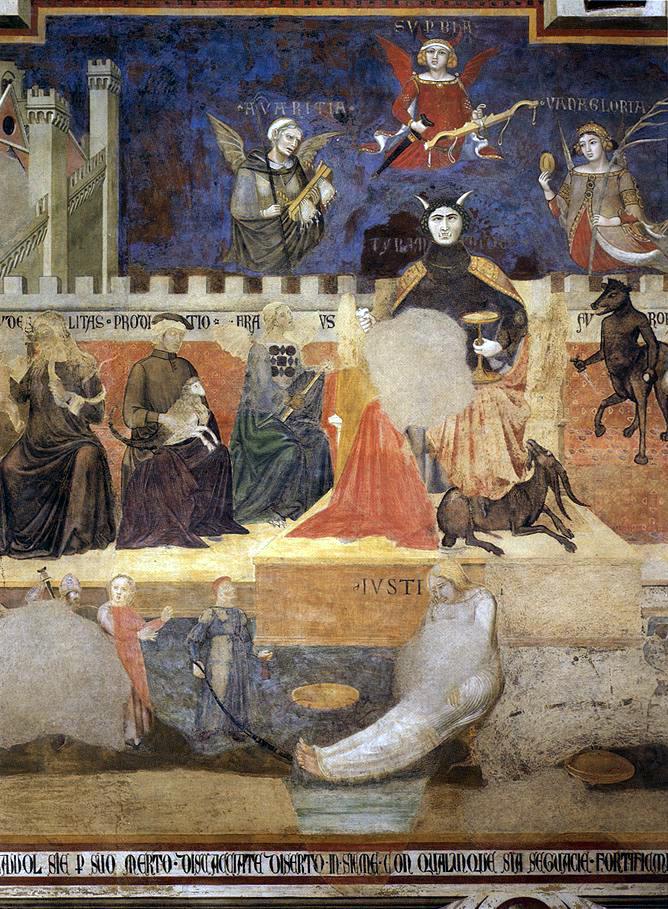
[ILLUSTRATION]. The Ambrogio Lorenzetti frescoes at Sienna (Palazzo Publico).
[1] Good government: equal justice, or the rule of law; [2] Good government: peace & prosperity in the city; [3] Peace, prosperity and SECURITY in the country side. [4] Tyranny: justice bound and gagged; [5] Tyranny: destruction inside the city; [6] Tyranny: the countryside.


References. Chiara Frugoni: "Gli affreschi nel Palazzo Pubblico di Siena", in her book Pietro e Ambrogio Lorenz1etti (Milan: Scala, 1988); Hans-Jürgen Wagener: "Good governance, welfare, and transformation", The European Journal of Comparative Economics, junio 2004; Quentin Skinner: "Ambrogio Lorenzetti's Buon Governo frescoes: two old questions, two new answers", Journal of the Warburg and Courtauld Institutes, LXII, 1999.

French photographer Henri Cartier-Bresson is in Shanghai just a Maoist troops are about to take the city, in late 1948. (1, 2, 3). Note the anguish of depositors. They are rushing to take their money out of banks. Some of them are looking to the photographer.
[QUESTION: What do you think was happening to the supply of loanable resources at that very moment? Are interest rate going up or down? Why?
____________
Iran, 2010
[DISCUSSION: “Iranians switch to informal savings funds as loans dry up”, Financial Times, March 13, 2010].
______________________
Argentina, 2009
Another fascinating case. The country has an enormous wealth of natural resources; it is huge. Yet its per capital GDP is stagnant; poverty is widespread. What is going on? Here’s a hint. Argentina’s Supreme Court on criminalizing small amounts of drugs. Most recent rulings: 1978 (criminalizing); 1986 (de-criminalizing); 1991 (criminalizing); 2009 (decriminalizing). [Not required reading! Jonathan Miller: "Judicial Review and Constitutional Stability: A Sociology of the U.S. Model and Its Collapse in Argentina", Hastings International and Comparative Law Journal, Vol. 77, No. 21, 1997].
In other words, the Argentine Supreme Court does not follow its own precedents!
Argentina: the concept of “strategic defection”, developed by Gretchen Helmke. Courts under Constraints. Judges, Generals, and Presidents in Argentina (New York: Cambridge University Press, 2005) [webpage] [see] [review].
________________________
England, 1300 (Braveheart)
In 1300, king Edward I is at war with the Scots. He needs lots of money. There is no tax system as we understand it today. The barons and the London merchants are unwilling to assist the king with more funds, unless he re-issues Magna Carta. "When we have secure possession of our forests, and of our liberties, often promised to us, then we will willingly give a twentieth, so that the folly of the Scots may be dealt with" (p. 525). Very interesting! It pays to strengthen the rule of law! Meanwhile, Edward puts tremendous pressure on courts to expropriate as much resources as possible. There is little information about the level of interest rates at that time, because lending at interest was forbidden by the Church. However, we learn that an investigation of Jewish bankers yields a very interesting discovery: many loans carry a 43% interest rate! (*)
(*) Michael Prestwich. Edward I (University of California Press, 1988).
___________________________
Europe & Precedents as a source of law
- The Netherlands: “There is no stare decisis in Dutch law, as there is in common law [mostly English-speaking countries], although in practice the Supreme Court will not usually overrule its own previous decisions” (Sanne Taekama, ed. Understanding Dutch Law. Boon Juridische uitgevers, 2004).
- The European Court of Justice: “Where a question referred to the Court for a preliminary ruling is identical to a question on which the Court has already ruled, where the answer to such question may be clearly deduced from existing case-law or where the answer to the question admits of no reasonable doubt, the Court may, after informing the court or tribunal which referred the question to it, give its decision by reasoned order in which, if appropriate, reference is made to its previous judgment or to the relevant case-law” (Hans Baade: “Stare Decisis in Civil Rights Countries: The Last Bastion”, in Peter Birks & Adrianna Pretto, eds. Themes in Comparative Law. In Honor of Bernard Rudden. Oxford: Oxford University Press, 2002);
- Finland Supreme Court (see): “The most important function of the Supreme Court is to establish judicial precedents in leading cases thus ensuring uniformity in the administration of justice by the lower courts”.
- Sweden Supreme Court (see): “Leave to appeal is required for a case to be considered. This is granted by the Supreme Court itself, basically only in those cases where it is important to establish a judgment that may provide guidance for the Swedish district courts and courts of appeal. Such judgments are called precedents”.
__________________
More stories
- Venezuela & “onerous financing costs”. Oil development in the Orinoco Belt is in jeopardy: “Repeated delays in the bidding for rights to exploit the Orinoco Belt reflect investor concerns about political risk, onerous financing costs and the profitability of the projects” (Benedict Mander: “Chávez a problem for oil groups eyeing vast field”, Financial Times). Note that both Venezuela and Iran are usually the most aggressive OPEC member countries when it comes to reduce output …
- Tunisia. Thomas Fuller: “Head of Reform Panel Says Tunisia Risks Anarchy as It Moves Toward Democracy”, The New York Times. Abdelrazek Kilani, president of the Tunisian Bar Association, estimated that “about 100 judges are totally corrupt” and needed to be removed. ‘They took bribes and followed orders from the Ministry of Justice,’ Mr. Kilani said in an interview. ‘They convicted people because the ministry told them to’. The country’s official unemployment rate is 14 percent, concentrated among young people, but the rate is much higher in Sidi Bouzid, say local union leaders, who put it at higher than 30 percent. Neglected by successive central governments, bereft of factories, seized with corruption and rife with nepotism, Sidi Bouzid and the small towns surrounding it are filled with idle young men, jobless, underemployed or just plain poor.
- From an IMF study. John D. Burger & Francis E. Warnock: “Local Currency Bond Markets”, IMF Staff Papers, Vol. 53, 2006 (only pp. 141-142). “The importance of institutional and policy settings suggests that even emerging economies have the ability to develop local currency bond markets. Emerging market economies are not predestined to suffer from original sin. To gauge the importance of various factors, our estimates in column 1 of Table 3 imply that (other things being equal) if Brazil had Denmark’s rule of law, its bond market as a share of GDP would be 43 percentage points higher. If Brazil had Denmark’s inflation history, its bond market would be 42 percentage points (of GDP) larger. These amounts are both economically significant—Brazil’s local currency bond market is currently only 22 percent of GDP—and suggest an important role for creditor-friendly policies in emerging markets. The results suggest that the determinants of the size of government and private bond markets are quite similar: Countries with better inflation performance and stronger rule of law have larger sovereign and corporate bond markets”. [MY COMMENT: Think about it! Brazil’s GDP is about $1.27 trillion. Now, 43 percentage points would mean that no less than $546 billion that could be made available to entrepreneurs and/or to the government (poverty reduction, etc)].
- Singapore. Lee Kwan Yew: Keynote speech , International Bar Association Conference, Singapore, October 14 2007: “Important for investors and economic growth is the rule of law, implemented through an independent judiciary, an honest and efficient police force, and effective law enforcement agencies. The rule of law would give Singapore an advantage in Southeast Asia where the law was often what was decided by the leader. A stable and predictable legal environment facilitates the enforcement of contractual rights and protection of property rights. The independence of our courts is protected by the constitution that prevents removal of judges by the executive. We still look to English precedents and examples, but increasingly we look as well to those of the US, Australia, New Zealand. This also needed a Chief Justice who is not only legally qualified, but also has managerial and administrative experience to reform the system. [We] selected the most able and balanced of those at the Bar to become judges. Good governance, a sound legal framework and judiciary have resulted in stability and economic growth”.
- United States. In most American states, local judges are elected by the people. According to The New York Times: “As spending in state judicial races by special interests has vastly escalated in recent years, so has the threat to public confidence in judicial neutrality that is fundamental to the justice system”. [New York Times: "Fair Courts in the Cross-Fire"].
- Nigeria. A BBC documentary highlights the case of a talented Lagos entrepreneur (in the gas station business) whose main complaint is the high cost of capital: 25%! By definition, credit depends on confidence and —as Adam Smith put if— on the performance of contracts. Can we trust the performance of contracts when we see scenes like this one?
_____________
Subscribe to:
Posts (Atom)